
Dholera Residential Zone
August 2026
Development Plan, GDCR, TP Scheme Documents

~9,780 hectares
Residential & Community
TP1, TP2, TP3, TP4, TP5, TP6
From 200 sqm
Dholera Draft GDCR
DICDL
Table of Contents
✓ Suitable For
- Building a home to live in
- Row houses, villas and apartment projects
- Residential developers and builders
- Schools, clinics and community facilities
- Long-term family investment
✕ Not Ideal For
- Factories or manufacturing units
- Warehousing and heavy logistics
- Large industrial sheds
- Any use that creates noise, fumes or heavy traffic
- Short-term buying and reselling
Illustrative representation of a planned environment. Not a photograph of current site conditions.
Overview
At roughly 9,780 hectares, the Residential Zone is the second largest land use in Dholera’s development plan, after industry (DSIRDA Draft Development Plan, Table 3-2). Around 17% of all developable land in the region is set aside for housing.
It isn’t one uniform residential area. The plan splits it by density: about 3,032 hectares for medium-density housing, 1,467 for low-density, and 782 for high-density. Another 978 hectares each go to community facilities and local open space, with smaller allocations for neighbourhood retail and leisure. So a residential neighbourhood here is meant to come with its schools, parks and shops built in, not added later.
As with every zone in Dholera, what you can build depends on the road your plot faces. A plot on a 55-metre road gets an FAR of 2.0 and can go up to G+5 or 18 metres. The same plot on a road under 25 metres gets FAR 1.0 and a G+2 or 10-metre limit. That’s half the built-up area on identical land.
Minimum plot size works differently here than in the industrial zone. There’s no single figure — it depends what you’re building. A row house needs 200 sqm, a villa 300 sqm, a low-rise apartment 500 sqm, and a multi-storey apartment 2,000 sqm (DGDCR Table 9-1).
Development is phased. Of the 9,780 hectares, 2,187 fall in Phase 1, 4,268 in Phase 2 and 3,326 in Phase 3 (DDP Table 4-2). Phase 1 land is where infrastructure comes first — and that shows up in the price.
1.0 – 2.0 (by road width)
G+2 to G+5 (10 m – 18 m)
8,000 to 40,000
Activation, Linear & Future
Permitted Uses


Development Regulations
| Road ROW | Min. Plot Size | Max FAR | Ground Coverage | Max Height | Setbacks |
|---|---|---|---|---|---|
| Plots on roads 55 m ROW and above | Varies by building type | 2.0 | 60% | G+5 or 18 m, whichever is less | 5m – 6m – 6m – 6m |
| Plots on roads 25 m to below 55 m ROW | Varies by building type | 1.5 | 60% | G+3 or 15 m, whichever is less | 5m – 5m – 5m – 5m |
| Plots on roads below 25 m ROW | Varies by building type | 1.0 | 50% | G+2 or 10 m, whichever is less | 3m – 3m – 3m – 3m |
Zone in Dholera
Where this zone sits within Dholera SIR, and which TP schemes and villages it covers.
Highlighted Residential Zone Map
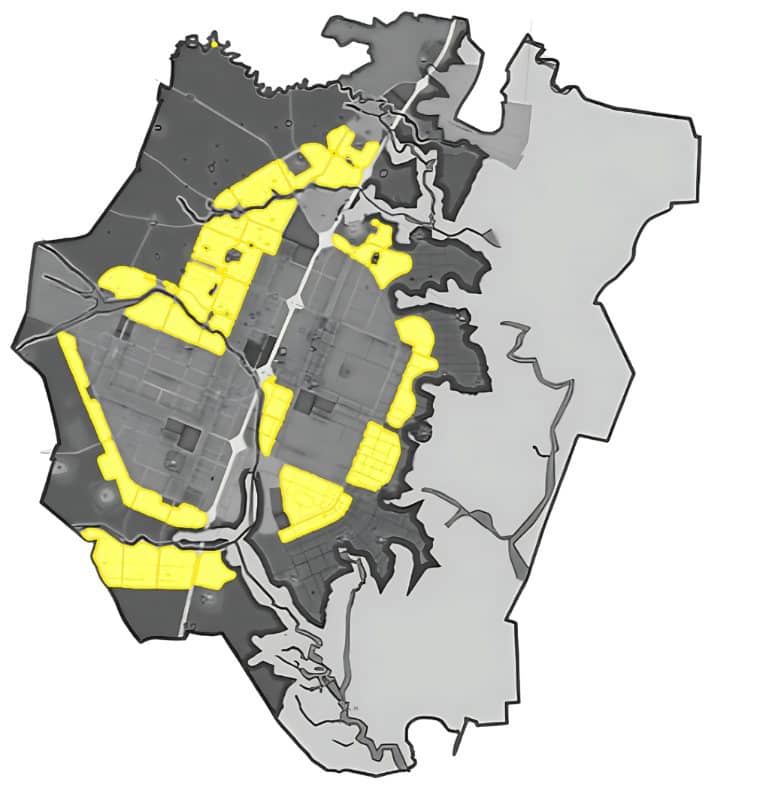
- TP Scheme 1
- TP Scheme 2
- TP Scheme 3
- TP Scheme 4
- TP Scheme 5
- TP Scheme 6
- Sangasar
- Sodhi
- Bhangadh
- Otariya
- Hebatpur
- Zankhi
- Bhangarh
Investment Perspective
This section is DholeraProp’s own assessment, based on published planning documents and observed on-ground status. It is not investment advice, and it makes no claim about future prices or returns. Please make your own checks before any purchase decision.
- Second largest land use in the Dholera plan, at about 9,780 hectares
- Development rules are published and public
- Plan reserves land for schools, parks and neighbourhood retail alongside housing
- Higher FAR than industrial land on comparable roads
- Roughly 2,187 hectares fall in Phase 1 of the development plan
- Plot-level development has started in some TP schemes
- Most residential land is still at an early stage
- Progress varies widely across different parts of the zone
- Row house and villa plots for end users
- Apartment projects for developers
- Neighbourhood retail and community facilities
- Long-horizon residential land holding
- Families planning to build a home in Dholera
- Residential developers and builders
- Buyers who want land near where employment will be
- Long-horizon investors — not short-term traders
Risks & Considerations
- Development is uneven. Some TP schemes are years ahead of others — check the specific survey number, not the zone as a whole.
- The regulations here come from a document that carries “Draft” in its title. Confirm the current notified position before you commit money.
- Most of Dholera’s residential land sits in Phase 2 and Phase 3. Infrastructure reaches those areas later.
- Housing demand follows employment. Residential value here depends on industry actually arriving and hiring.
- Zone classification alone doesn’t make land buildable. Title, legal road access and approvals all need separate checking.
- Minimum plot size depends on what you build. A plot big enough for a row house may not be big enough for an apartment.
Indicative Land Prices
There’s no single price for residential land in Dholera. Where the plot sits matters more than almost anything else about it.
The Residential Zone spreads across areas at very different stages of development, and most of it — about 7,600 of its 9,780 hectares — falls in Phase 2 and Phase 3 of the plan. Land where roads and utilities are already in costs several times what land in a still-planned area costs. Here’s roughly where things stand.
| Location | What it means | Indicative rate |
|---|---|---|
| Activation Area | Roads, utilities and trunk infrastructure already in place. This is where Dholera's existing industries are. | ₹20,000 – ₹40,000 per sq. yard |
| Linear Development | Sub-TP schemes running along both sides of the expressway. Work has started and final draft maps are out. | ₹12,000 – ₹20,000 per sq. yard |
| Future Development | The remaining sub-TP schemes. Planned, but development hasn't begun. | ₹8,000 – ₹15,000 per sq. yard |
Unlike industrial land, there’s no single minimum plot size here — it depends what you’re building. A row house needs 200 sqm (about 240 square yards), a villa 300 sqm, a low-rise apartment 500 sqm, and a multi-storey apartment 2,000 sqm.
At current rates, that means a row-house plot starts at roughly:
- ₹8000 to ₹15000 in a Future Development area
- ₹12000 to ₹2000 in a Linear Development area
- ₹20000 to ₹40000 in the Activation Area
A villa plot runs about 1.5 times that, and land for a multi-storey apartment project ten times.
You’ll notice the bands overlap. That isn’t sloppiness — it’s how the market actually behaves. A well-placed parcel in a Future Development area can cost more than a poorly placed one in Linear Development. Six things decide where a specific plot lands:
- Which zone it’s in. Land use changes value. High Access Corridor, City Centre and Knowledge & IT land prices well above industrial and residential land, because what you’re allowed to build there is worth more per square yard.
- Which TP scheme. Even within the same development phase, TPs don’t price alike.
- Road and access. Not just width. Direct frontage versus an internal road, a corner position, access from two sides, how close the expressway runs. Wider roads also carry a higher FAR, so you can build more on the same plot.
- The parcel itself. Size, shape, how deep it is relative to its frontage, whether adjoining land is available, whether it’s low-lying or already filled, and where your final plot ends up after the TP scheme reorganises boundaries.
- Legal readiness. Clear title, clean ownership entries, no encumbrances, NA status where it applies, and how many co-owners have to sign. Land that’s ready to transact is worth more than identical land that isn’t.
- What’s on the market right now. Inventory and demand shift month to month.
These are the rates we’re seeing as of August 2026. For what’s current on a specific TP scheme or plot size, message us on WhatsApp — we’ll tell you where things actually stand.
Indicative bands based on current seller quotations, buyer enquiries and DholeraProp market observations, as of August 2026. These are not official or government-fixed rates. Actual pricing depends on the specific parcel, its TP scheme, road access, legal status and what’s available at the time.
Available Properties
Listings are offered by private parties. DICDL and DSIRDA are not involved in private
property transactions.
Frequently Asked Questions
What is the Residential Zone in Dholera SIR?
What is the price of residential land in Dholera?
What is the maximum FAR in Dholera's Residential Zone?
What is the minimum plot size for a house in Dholera?
Can I run a business from my house in Dholera?
Can I build a shop in the Residential Zone?
Primary References
Information on this page is compiled from the following publicly available documents.
Published by DSIRDA
General Development Control Regulations
Applicable TP scheme documents
State and authority notifications
Talk to our team before you commit to anything. No pressure, no spam.
Our experts are here to help you make the right decision.
Explore verified land & plot listings in Residential Zone.
Use this checklist before finalising any purchase.
Information on this page is compiled from publicly available government documents and other verified sources. Please verify all details with the relevant authority. Read Full Disclaimer →