
Last reviewed 14 November 2026
Two Dholera listings, two different rulebooks
Imagine two listings on your phone.
One says: “Land Inside Dholera Smart City.”
The other says: “Residential Plot Near Dholera SIR.”
Both say Dholera. Both sound promising. So what’s the difference?
Quite a lot, actually. The first sits inside a notified Special Investment Region, where a planning authority decides how every piece of land can be used. The second sits in a nearby village, where ordinary revenue records and land-conversion orders decide what you can do.
Neither is automatically “better”. They suit different buyers, different budgets and different plans. But if you buy one while expecting the rules of the other, you can end up with the wrong land for your goal.
Let’s make sure that doesn’t happen.
The short answer
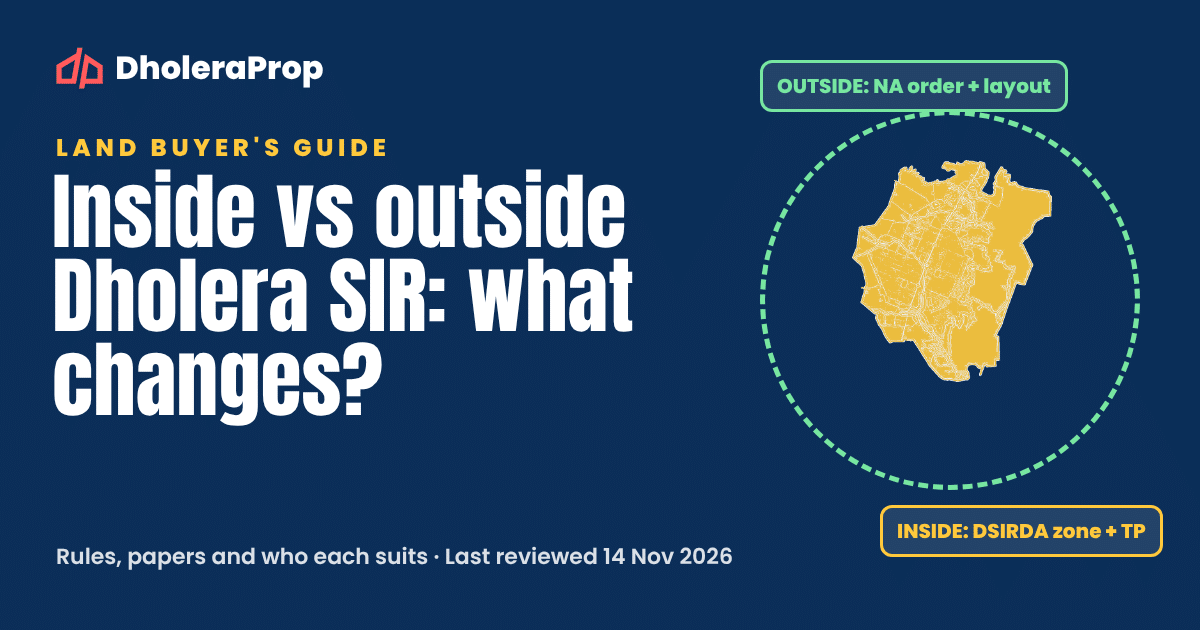
Inside the SIR, land is planned by the Dholera Special Investment Region Development Authority (DSIRDA). Its Development Plan sets the zone (residential, industrial, commercial and so on), and town planning (TP) schemes redraw old survey numbers into “final plots”. Today, land inside mostly changes hands as large parcels; new plotting projects are not being approved there.
Outside the SIR, DSIRDA’s zones and TP schemes don’t apply. The land follows Gujarat’s revenue rules, and a property’s use depends on its own non-agricultural (NA) permission and approved layout. This is where plotted residential projects for individual buyers exist today.
The rest of this guide explains why, and how to check which side a property is on.
First, understand the boundary
Dholera SIR is a notified region of roughly 880 to 920 sq km. DSIRDA’s own Draft Development Plan gives both numbers: about 878 sq km from the original site data and about 920 sq km after GIS validation (DSIRDA Draft Development Plan, Table 3-2 notes).
It covers 22 revenue villages, all in Dholera taluka, Ahmedabad district. The full list is on our SIR villages page.
Two things to remember:
- The boundary follows survey numbers, not just village names. Many villages that share a name, a road or a taluka with the SIR sit outside it. Check the survey number, not just the village.
- Distance phrases don’t settle the boundary. “0 km from SIR”, “touching the SIR” or “near TP-5” tell you where to look, not which side of the line the plot is on. “Near TP-5” only tells you the plot is not in TP-5. A plot is either within the notified boundary or it isn’t, and its survey number decides that.
What changes when you buy inside the SIR
DSIRDA plans the land. The Gujarat Special Investment Region Act, 2009 makes DSIRDA the authority that prepares the Development Plan and the TP schemes for the region (GSIR Act 2009, s.15 and s.17). No one may put up a building inside the SIR without its prior permission (same Act, s.16(2)).
Your zone decides your use. The Development Plan puts every parcel in a zone: Residential, Industrial, City Centre, High Access Corridor, Knowledge & IT, Recreation and others. You can’t build a house on industrial land, however cheap it looks. Zone details are on our zones guide.
Your survey number becomes a “final plot”. Dholera SIR is covered by six TP schemes, split into 27 sub-schemes. As of our last check, 13 sub-schemes are at the Preliminary stage and 14 at the Draft stage; none has reached Final. In Preliminary sub-schemes, the final plot (FP) is fixed and shows on the new 7/12 record. In Draft sub-schemes, the FP is read off the scheme map and can still change. Either way, the land you end up with may differ in shape, size or road frontage from the survey number you bought, because part of it goes to roads and public use. Scheme-by-scheme detail is on our TP schemes page.
Why small buyers don’t find plots inside the SIR today
This is the part most listings skip.
New plotting projects are not being approved inside the SIR. Around 2021, a few plotting projects inside the SIR received permission and GujRERA registration. In our experience of the Dholera market, permission for new plotting-only projects has not been given since about 2022, even though construction projects such as villas and apartments can still be approved (DholeraProp market note). Most of those earlier plotted projects have already sold out.
So what trades inside today is land as land: whole parcels, usually measured in bighas or acres, bought by investors, businesses and developers. Budgets for these deals commonly run into several crores.
If someone offers you a small plot inside the SIR, ask for its GujRERA registration number. Then check on the GujRERA portal that the number belongs to that same project and that your plot is part of it. An old registration shown for a new layout is a red flag.
Even the planning rules point to larger plots. Dholera’s draft development regulations set minimum plot sizes by building type. A row house needs at least 200 sq m (about 240 sq yd), a villa 300 sq m, and a multi-storey apartment 2,000 sq m (Dholera Draft GDCR, Table 9-1).
Most planned housing land comes later. The Development Plan gives the Residential zone about 9,780 hectares, roughly 17% of developable land. Industry gets about 11,457 hectares, the largest single use. Only about 2,187 hectares of the Residential zone sits in Phase 1; the rest is in Phases 2 and 3 (DSIRDA Draft Development Plan, Tables 3-2 and 4-2).
So if you are an individual buyer with a household budget, the honest answer is this: inside the SIR, there isn’t a residential plot for you to buy today. That’s not a judgement on the SIR. It’s simply how the market works there at this stage.
What changes when you buy outside the SIR
Outside the notified boundary, DSIRDA’s zones and TP schemes don’t apply. The land is governed by Gujarat’s revenue rules.
The NA permission matters, but it isn’t the whole story. Agricultural land has to be permitted for non-agricultural use before it can become a residential plot. Which office grants that permission can depend on the location, the land category and the rules in force. So don’t stop at “it’s NA”. Ask for the actual NA order and read four things on it: the issuing office, the survey number, the permitted use, and the conditions.
An NA order is not proof of ownership. In a November 2026 order, the Gujarat High Court restated that when the Collector decides an NA application, the Collector does not decide title (Gujarat High Court, Bhumikaben v. Collector, Ahmedabad, order of 5 Nov 2026). You still need a proper title search.
“Plan pass” should come with a paper. If a seller says the layout is approved, ask to see the approved plan and the name of the office that approved it.
One more check: the periphery. The GSIR Act allows the state to notify a periphery of up to 3 km around an SIR, where DSIRDA’s powers would also apply (GSIR Act 2009, s.27). We have not found such a notification for Dholera as of November 2026, but please confirm it for your parcel.
For buyers looking at large outside-SIR parcels rather than plots, our bulk land outside Dholera SIR guide goes deeper.
Where will the people who work here live?
Here’s a question worth thinking about, without turning it into a price forecast.
The Development Plan expects Dholera SIR to support more than 8 lakh jobs at full build-out. It plans housing inside the city for about 80% of the households linked to those jobs (DSIRDA Draft Development Plan, sections 3.4.4 and 5.1). By the plan’s own design, the rest are expected to live outside.
Add the phasing above, where most residential land inside comes in later phases, and a practical picture emerges. Some of the people who come to work in Dholera will look for homes nearby. The villages adjoining the boundary are the closest places where residential plots can be bought and built on today.
We are not saying any plot will rise in value. That depends on many things nobody can promise, including how fast industry actually arrives. What we are saying is that location matters: if you want a residential plot near the SIR, closer to the boundary generally means a shorter commute to where the jobs are planned, so don’t go too far out just because land is cheaper there.
Inside vs outside: side by side
| Inside Dholera SIR | Outside Dholera SIR (adjoining villages) | |
|---|---|---|
| Who plans the land | DSIRDA (GSIR Act 2009) | Revenue rules; no DSIRDA plan unless a periphery is notified |
| What decides use | Development Plan zone + TP scheme | NA order and approved layout |
| Small residential plots | No new plotting approvals; older projects mostly sold out | Available in approved plotted projects |
| Typical buyer today | Investors, businesses, developers | Individual buyers and families |
| Typical ticket size | Large parcels, often several crores | Plots within household budgets |
| Key papers | 7/12, TP scheme and FP number, zone | 7/12, NA order, approved layout, title |
| Main risk | FP can change in Draft sub-schemes | Weak or missing NA or layout approval |
Which one makes sense for you?
Buyer A: you want a large land parcel for the long term. Inside the SIR may suit you, if your budget and timeline fit. Check the zone (is it the use you want?), the TP stage (Preliminary or Draft?), the FP number and the title.
Buyer B: you want a residential plot for your family or a first investment. Look at approved plotted projects in the adjoining villages, close to the boundary. Check the NA order, the approved layout, the actual plot area, road access, and the title.
Buyer C: you’re not sure yet. Start with the village and survey number of anything you’re shown. That one check tells you which rulebook applies, and which questions to ask next.
These are illustrative situations, not recommendations of any specific parcel.
Five common mistakes Dholera buyers make
- Trusting the word “Dholera”. A brochure title isn’t a boundary. Check the survey number.
- Reading “near TP-5” as “inside TP-5”. “Near” tells you the plot is not in that scheme. It doesn’t tell you whether the plot is inside the SIR; check the survey number.
- Stopping at “NA approved”. Read the actual NA order: survey number, use, office, conditions.
- Treating an approval as a title. Neither an NA order nor a 7/12 entry settles ownership. A title search does.
- Buying far away because it’s cheaper. Distance from the boundary matters for daily life later. Measure it on the official map, not from the brochure.
Documents to check before you pay
For any land, inside or outside:
– 7/12 and 8A extracts from AnyROR. Check the village and taluka on the extract itself.
– A title search by an advocate, covering the full chain of sale deeds
– Mutation entries, and who the record shows as the occupant
Inside the SIR, also:
– The TP sub-scheme and its stage (Preliminary or Draft)
– The final plot (FP) number and its zone
– DSIRDA permission for anything already built on the land
Outside the SIR, also:
– The NA order: issuing office, date, survey number, permitted use, conditions
– The approved layout plan, and the office that approved it
– Whether the land falls in any notified SIR periphery
Our land verification guide walks through each of these.
Frequently asked questions
Is all land called “Dholera” inside Dholera SIR?
No. Only land within the notified boundary of the 22 SIR villages is inside. Many listings use “Dholera” for nearby villages that are outside.
Can I buy a small residential plot inside Dholera SIR?
Practically, no. In our experience, new plotting-only projects haven’t been approved inside the SIR since about 2022, and the few older approved projects have mostly sold out. What trades inside today is mostly large land parcels. If you are offered a plot inside the SIR, check its GujRERA number on the GujRERA portal before paying anything.
How do I check if a survey number is inside the SIR?
Pull its 7/12 on AnyROR to confirm the village, check whether that village is one of the 22 SIR villages, and then check the survey number against DSIRDA’s plan map. Boundary villages need the survey-level check.
Do TP schemes apply outside the SIR?
No. The six TP schemes cover land inside the SIR only.
Does an NA order prove the seller owns the land?
No. It shows the land is permitted for a non-agricultural use. Ownership needs a separate title search.
Is Dholera airport inside the SIR?
No. The airport site is near Navagam, which is not one of the 22 SIR villages. The airport serves the SIR, but its land is outside it.
The bottom line
Inside the SIR, you’re buying into a planned city: large parcels, clear zones, and a longer road to finished infrastructure. Outside, you’re buying a plot whose strength depends entirely on its own papers.
Both can make sense. The mistake is not knowing which one you’re buying.
Not sure which side a property is on? Send us the village name and survey number. We’ll tell you which rules apply and which documents to ask for before you decide. WhatsApp DholeraProp: 93284 34849. This second opinion is free.
This guide is general information, not legal or investment advice. Rules and scheme stages change; confirm the current position for your specific parcel.
Sources
- DSIRDA, Draft Development Plan (Tables 3-2, 3-3, 4-1, 4-2; sections 3.4.4, 5.1) and TP scheme drawings: https://dholera.gujarat.gov.in
- Gujarat Special Investment Region Act, 2009 (India Code): https://www.indiacode.nic.in/bitstream/123456789/6138/1/the_gujarat_special_investment_region_act%2c_2009.pdf
- Gujarat High Court, Bhumikaben v. Collector, Ahmedabad, SCA 13992 of 2026, order of 5 Nov 2026 (via LiveLaw): https://www.livelaw.in/pdf_upload/2026/11/09/4-710609.pdf
- AnyROR, Gujarat Revenue Department land records: https://anyror.gujarat.gov.in
- Dholera Draft GDCR, Table 9-1 (summarised on our residential zone guide): https://dholeraprop.com/zones/dholera-residential-zone/
Reviewed by Vishal Shrivastav, Founder, DholeraProp · Last reviewed November 2026
