

Latest Update
On May 13, 2026, the Cabinet cleared the Ahmedabad (Sarkhej)–Dholera Semi High-Speed Double Line — PM Modi chaired the meeting himself. Same day, the government’s press office (PIB) put out an official release confirming it. So this has moved well past the “there’s talk of a rail line” stage.
What makes it a bigger deal than your average rail announcement: this is being called India’s first semi high-speed rail line built with homegrown technology. It also fits into the government’s broader PM Gati Shakti plan, which is basically the effort to get roads, rail, ports, and airports all planned together instead of as separate pieces.
Route & Speed
The line runs about 134 km from Sarkhej, on Ahmedabad’s edge, straight to Dholera. Trains are built to handle up to 220 km/h, though day-to-day running speed will likely be closer to 200 km/h. That works out to a Sabarmati-to-Dholera trip of around 48 minutes — short enough to be a commute rather than a journey.
It’s not just Ahmedabad-to-Dholera either. The plan also links up the Dholera International Airport and the Lothal National Maritime Heritage Complex, a well-known archaeological site. One corridor, three very different destinations — an industrial city, an airport, and a heritage site.
Why It Matters
Today, Ahmedabad to Dholera means a couple of hours on the road. Cutting that to under an hour by train would meaningfully change who can live near Dholera while working in Ahmedabad, or visit for a meeting without planning an overnight stay. For a region trying to attract industry, workers, and residents at the same time, that kind of connectivity is a genuine upgrade.
The catch: none of that benefit exists until the train is actually running, and that’s still some years away — more on that below.
Engineering Scale
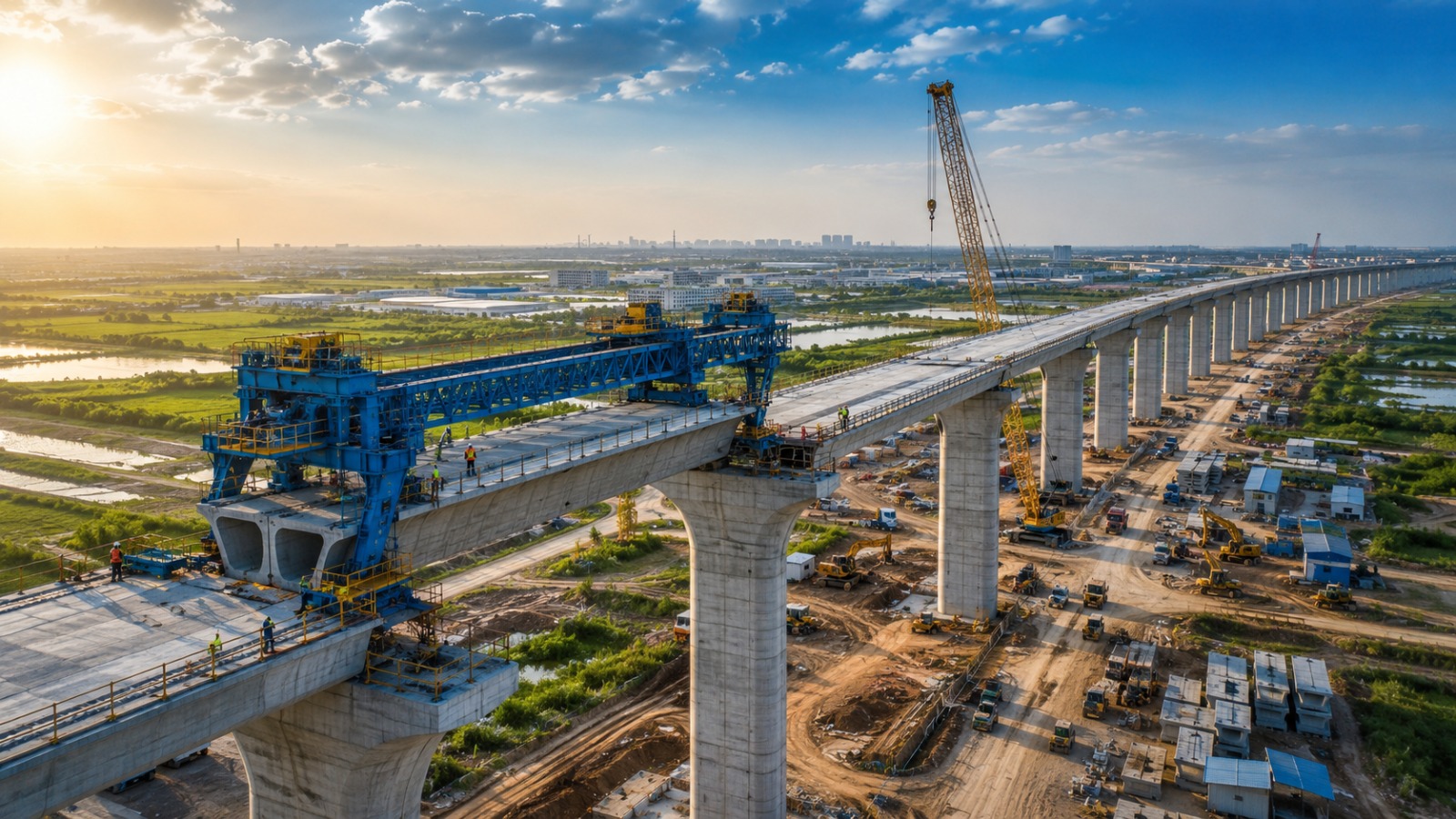
This isn’t just track laid on the ground — it’s a serious civil-engineering project. Per Indian Infrastructure and Metro Rail News, the coverage of the Cabinet approval mentions:
- 3 major bridges
- About 74 km of the route on elevated viaduct
- 39 road-under-bridges
- 2 rail-over-rail bridges
Trains running this fast need a straighter, smoother path than regular trains — level crossings and sharp turns don’t work well at 200 km/h, so a large share of the route will run on elevated pillars instead of ground-level track.
Timeline
The official completion target is 2030-31. That’s a real number the government has stated, not a guess — but it’s also more than four years from now. Large Indian rail infrastructure projects have a track record of timeline slippage, sometimes by a couple of years. Cabinet approval is a genuinely major milestone, but it marks the start of the process, not its completion.
We haven’t seen confirmation yet of construction start dates, contractor awards, or land acquisition status for this specific line. We’ll update this article once that information becomes available.
At a Glance: What’s Confirmed vs. What’s Not Yet
| ✅ Confirmed | ⏳ Not Yet Confirmed |
| Cabinet approval (May 13, 2026) | Construction start date |
| Project cost (₹20,667 crore) | Contractor details |
| Route (Sarkhej–Dholera, 134 km) | Exact station locations |
| Design speed (220 km/h) | Land acquisition status |
Our Assessment
This is a meaningfully stronger confirmation than most Dholera infrastructure news — it has an actual Cabinet decision and a same-day government press release behind it, which is about as solid as it gets before construction begins. At the same time, 2030-31 is a long horizon. If this rail line is part of why you’re considering Dholera, that’s a fair, credible reason for long-term optimism about the region — just not something that changes accessibility this year or next.